About
I believe the environmental and climate challenges we face can be met through collective action, collaboration, and bringing together diverse forms of knowledge — across scientific disciplines, communities, and cultures — to inform decisions and drive meaningful change. That conviction has held across more than fifteen years of applied research, program leadership, and fieldwork on four continents. Over time, I've become far more attuned to what actually stands in the way, and to how I can be a better leader and collaborator in moving it.
My research examines how individuals, households, communities, and institutions manage scarce resources and build resilience under social and environmental pressure. Questions of equity and justice — and how they are embedded in institutional arrangements — run through work that has spanned land and water systems, food systems, and communities on the front lines of climate change. I use mixed methods, combining qualitative and quantitative tools to answer questions that neither can fully address alone, and I consistently seek out collaborators who bring complementary skills, disciplines, and perspectives. I'm equally committed to producing rigorous scholarship and to improving how evidence reaches policy and practice.
Origins
I came to the social and environmental sciences through a combination of curiosity and eagerness to engage with diverse communities around the world. As an undergraduate and later as a research technician at the University of Arizona, I worked on NASA- and USDA-funded environmental and citizen science projects in southern Arizona that concerned urban planning, invasive grass species mapping, documenting rural-urban land use change, and promoting youth civic engagement, nutrition, and physical activity through the use of geospatial technologies.
These early experiences showed me how important it is to bridge the gap between scientific knowledge production and community practice. At the same time, my interdisciplinary degree program in International Studies challenged me to approach the world through the lens of problems, not disciplines. Disciplines simply offered different boxes of tools to understand a problem. My job was to figure out which ones to use and when, and how to put together diverse teams with complementary expertise that could work together to address a social or environmental challenge.
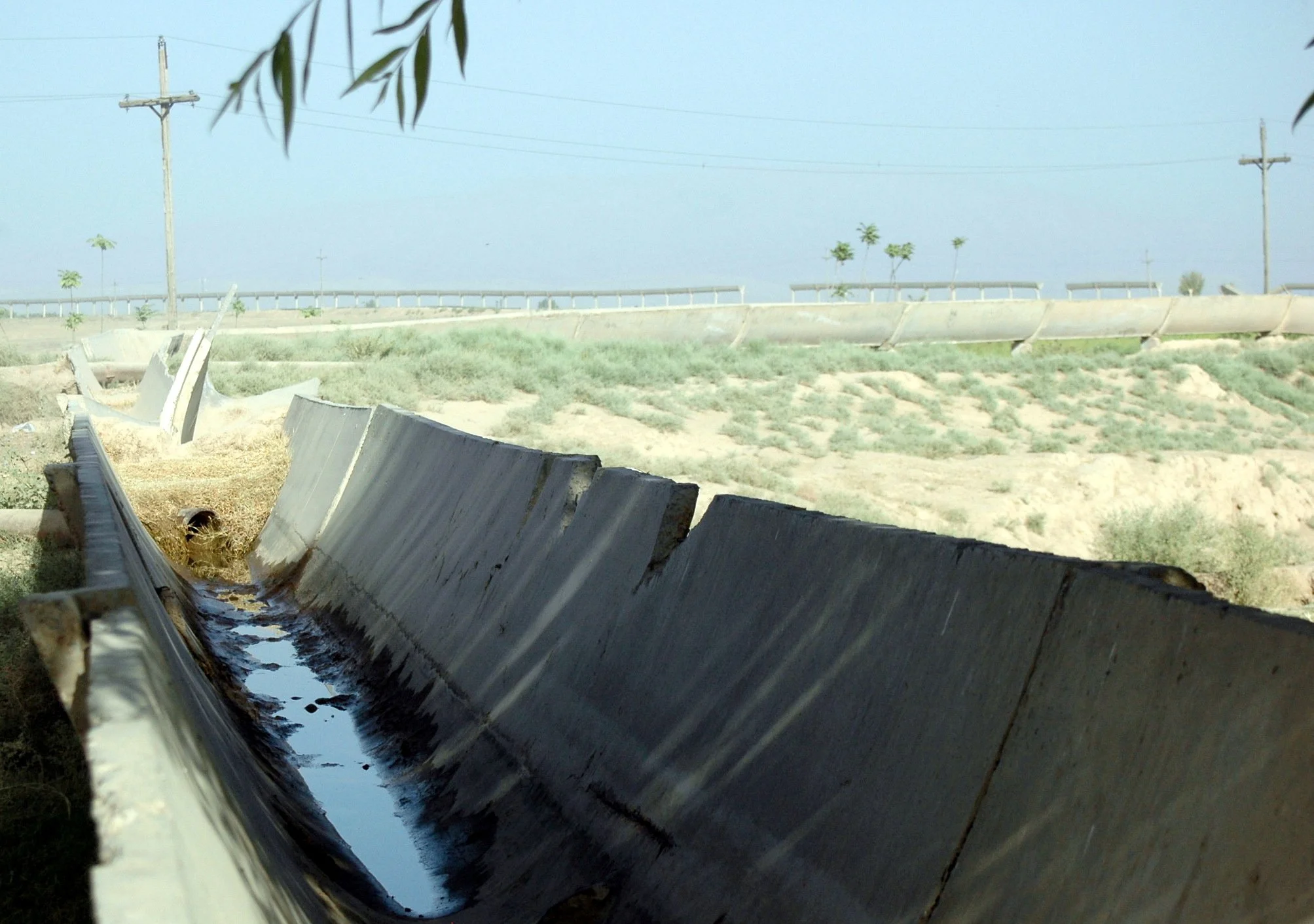
A Fulbright Fellowship in northern Tajikistan deepened that instinct along with a lifelong pursuit of cultivating mutual respect for peoples and cultures globally. While living and working in communities navigating the collapse of Soviet-era irrigation systems and land degradation, I saw firsthand what happens when governance institutions fail the people who depend on them. I also saw what it looks like when communities find ways to rebuild them on their own terms.
That experience shaped my doctoral research at Duke University, where I completed a PhD in Environmental Social Science studying how new institutions for community-based water governance take hold, or fail to. By examining newly formed Water User Associations in Tajikistan, I found that new institutions require certain conditions to succeed: trust and reciprocity among resource users, institutional arrangements that allow communities to shape the rules they live by, and enough time and autonomy for those rules to become normative behavior rather than externally imposed. Institutions that best serve people and the environment are not built by decree, but by the slow accumulation of trust, participation, and local ownership. This insight has stayed with me across every program, partnership, and initiative I have built since.
Building the Practice
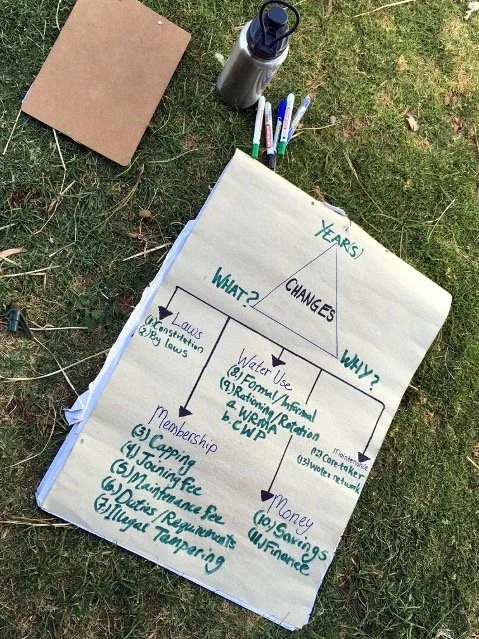
After completing my doctorate, I joined the University of Arizona as a Postdoctoral Research Associate, where I led NSF-funded research on land, water, and rural-urban food systems, primarily in Kenya, Zambia, and South Africa. That work introduced me to a set of collaborators, questions, and communities that have continued to inform my research. This training also marked a greater shift from single-site, dissertation-style inquiry toward the kind of multi-country, multi-partner research that characterizes most of my work today.
In the subsequent years, I moved from Postdoctoral Researcher to Research Scientist to Assistant Research Professor, taking on progressively larger and more complex initiatives. I served as Program Manager for a $5M humanitarian assistance technical support initiative, Co-Principal Investigator on a $1M USAID-funded project evaluating humanitarian preparedness and land-based interventions, co-founder of a $2M USAID-funded pilot of the Climate Adaptation Research Program to support early-career researchers across the PERIPERI-U network of African universities, and ultimately as Principal Investigator of the $10M+ matured Climate Adaptation Research Program spanning Africa, Latin America and the Caribbean, and the Pacific Islands.
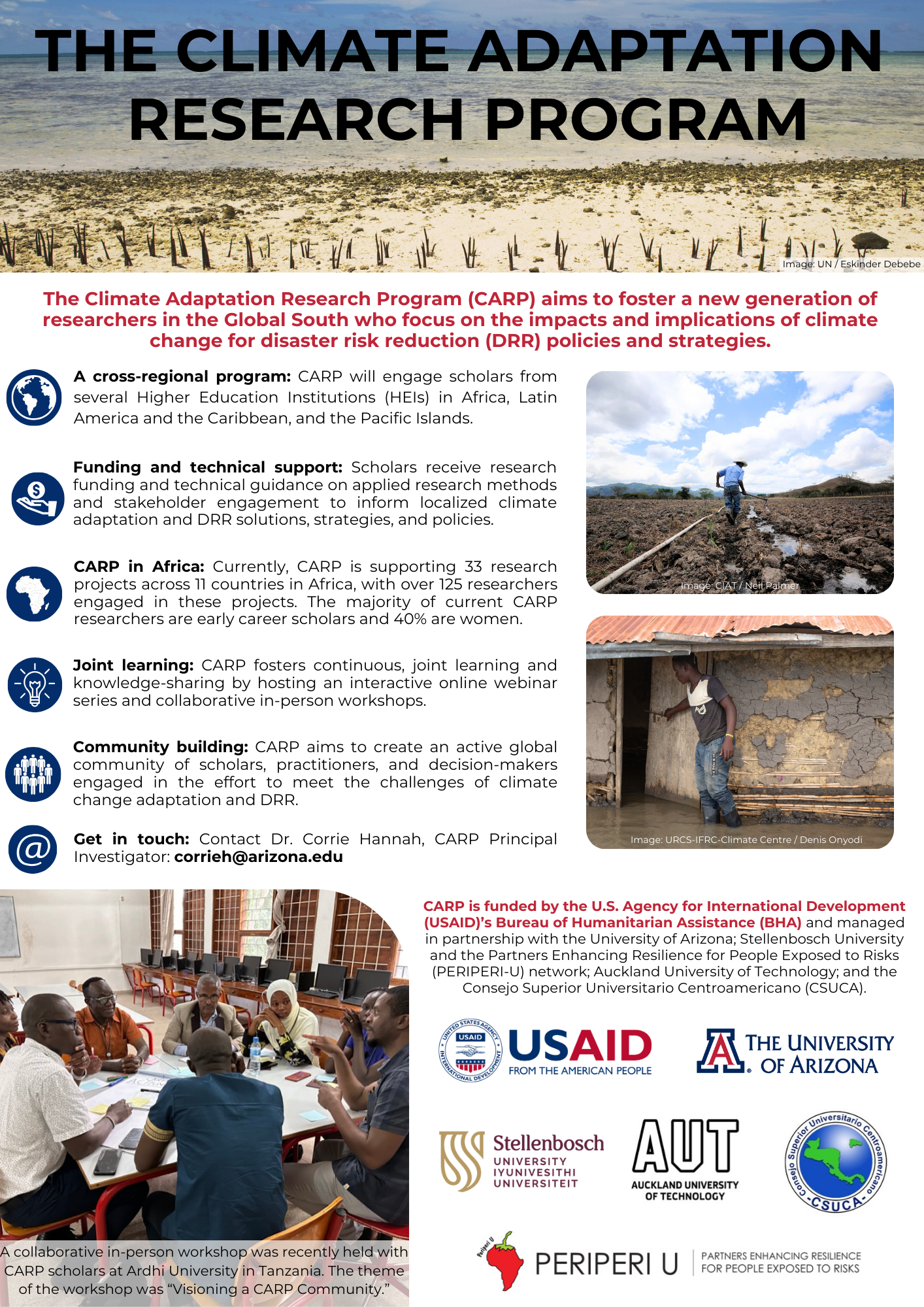
The Climate Adaptation Research Program, or CARP, was the most ambitious and collaborative research endeavor I have ever been part of building. Over the two-year pilot, it supported more than 125 early-career scholars from across the Global South to conduct applied disaster risk reduction and climate adaptation research that would strengthen decision-making and climate adaptation action in their own communities. The expanded CARP established partnerships with the Consejo Superior Universitario Centroamericano in the Latin America and Caribbean region and the Auckland University of Technology in the Pacific Islands region. An additional 75 research projects were selected in the African and Latin American regions to support locally impactful and regionally relevant research. The CARP ran competitive, multi-region funding calls, delivered six in-person, multi-day workshops across three continents, and established a 15-session global webinar series focused on research skills and evidence-to-decision pathways. CARP was designed to be a long-term, transcontinental platform, but it concluded early in 2025 following federal funding terminations tied to changes in U.S. government priorities. Alongside the hundreds of individuals that directly shaped this program, this is a loss I feel acutely, and a reminder of how fragile even well-built programs can be when their funding depends on political will.
How I Work
Across these experiences, a few commitments have remained constant. I believe rigorous science and community knowledge and engagement are both necessary, and the most important work happens at their intersection. I have spent my career trying to build research programs and partnerships that take both seriously.
I believe the translation problem of getting evidence into the hands of people who can act on it is as important as the research itself. Publishing in academic journals is important, because it is a verified and recognized way of advancing the body of knowledge on a topic. However, producing policy notes for municipal leaders in Zambia, facilitating workshops for practitioners in Kenya, and building the learning and knowledge exchange platforms that reach people who will never read a peer-reviewed article are equally important.
I believe in building things that last. The most common failures and disappointments I have seen in international research and development is the program that produces good outputs and leaves little behind in terms of outcomes. I strive to work differently by investing in relationships, institutional capacity, and local leadership that outlast any single grant cycle or research project.
Where I Am Now
I am currently based in Flagstaff, Arizona, but am available for travel and/or relocation for the right opportunities. I am a co-founder of Global Fair Share Games, an experiential learning venture that translates environmental governance challenges into collaborative game-based learning experiences. I continue to write, consult, and advise at the intersection of climate adaptation, environmental governance, and applied research. My research has produced 18 peer-reviewed publications across these thematic areas
I am available for senior research and program leadership roles, consulting engagements, and strategic partnerships with organizations serious about connecting evidence to action in service of people and the environment.
If any of the information shared above resonates, let’s connect. I enjoy meeting people in person over coffee or over Zoom if we're not in the same location. Reach out to corriehannah.research@gmail.com.